
Cheboygan Release Date Labels
Michigan OTIS does not publish one universal field called “Projected Release Date.” For an MDOC sentence, the public profile can display an Earliest Release Date, a Maximum Discharge Date, and actual status dates such as Date Paroled. Each label answers a different question. The Earliest Release Date, or ERD, is generally the first point when the Michigan Parole Board can acquire jurisdiction under the minimum sentence. It is not an order that the person must leave prison that day.
The Maximum Discharge Date is the outside sentence or discharge point shown for the live record, subject to the sentence and governing law. Date Paroled records an actual transition from prison into parole supervision. An MDOC discharge ends state corrections supervision for that sentence. None of these dates automatically proves the exact time a Cheboygan County jail booking ended.
- ERD
- The first date when the Parole Board may gain jurisdiction for an applicable sentence.
- Maximum Discharge Date
- The outside end shown for the sentence if no earlier lawful release or discharge occurs.
- Date Paroled
- The recorded transition from prison to parole supervision.
- Detainer
- A request or legal basis for another authority to take or keep custody.
Cheboygan Custody Changes the Date
The correct release-date source follows the custodian. The Cheboygan County Jail holds pretrial detainees and people serving local sentences of one year or less. It is not an MDOC prison. OTIS expressly excludes people whose only custody is a county jail or city lockup. A Cheboygan arrest appears in OTIS only when the person separately enters an MDOC category such as prison, parole, felony probation, or recent MDOC discharge.
| Custody situation | Date source | What the date means |
|---|---|---|
| Pretrial at Cheboygan County Jail | Court bond/order and sheriff custody record | No fixed sentence end; release depends on the order, processing, and holds |
| Local jail sentence | Judgment, jail credit, and sheriff time/release record | County sentence calculation and actual jail exit |
| MDOC prisoner | OTIS profile and MDOC records | ERD, maximum date, status, or parole information |
| Released to parole | OTIS Date Paroled and MDOC parole order | Transition to community supervision, not discharge |
| Transfer to another authority | Sheriff transfer record and receiving agency | Departure from one facility, not necessarily community release |
A court order and a jail transaction are complementary. The first supplies the legal authority. The second records execution. When a person leaves Cheboygan custody for MDOC, another jail, federal custody, or immigration custody, describe the event as a transfer unless the record supports community release.
Find Cheboygan Projected Release Dates
Begin with identity and custody type, not arithmetic. A date copied from the wrong system can be accurate for that system and still fail to answer the Cheboygan County question. The OTIS live search is the official public route for a sentenced state prisoner. The sheriff and the sentencing court are the local routes for a county-jail case.
- Confirm whether the person is at the Cheboygan County Jail, an MDOC prison, or another authority. Do not assume that arrest location identifies current custody.
- For MDOC, search by exact offender number when known. Otherwise use the name and only enough added filters to distinguish the person.
- Compare identifiers, then transcribe the profile’s exact label, date, status, and retrieval date.
- For a local sentence, review the judgment, jail credit, bond or release order, and any concurrent or consecutive terms in the correct Cheboygan court file.
- Ask the Cheboygan County Jail for the existing time or release record when the calculation or physical exit remains unclear.
- Check the receiving agency when the sheriff record identifies a transfer or detainer rather than release to the community.
The official OTIS form displays the Michigan status filters and person-search fields used in that process:
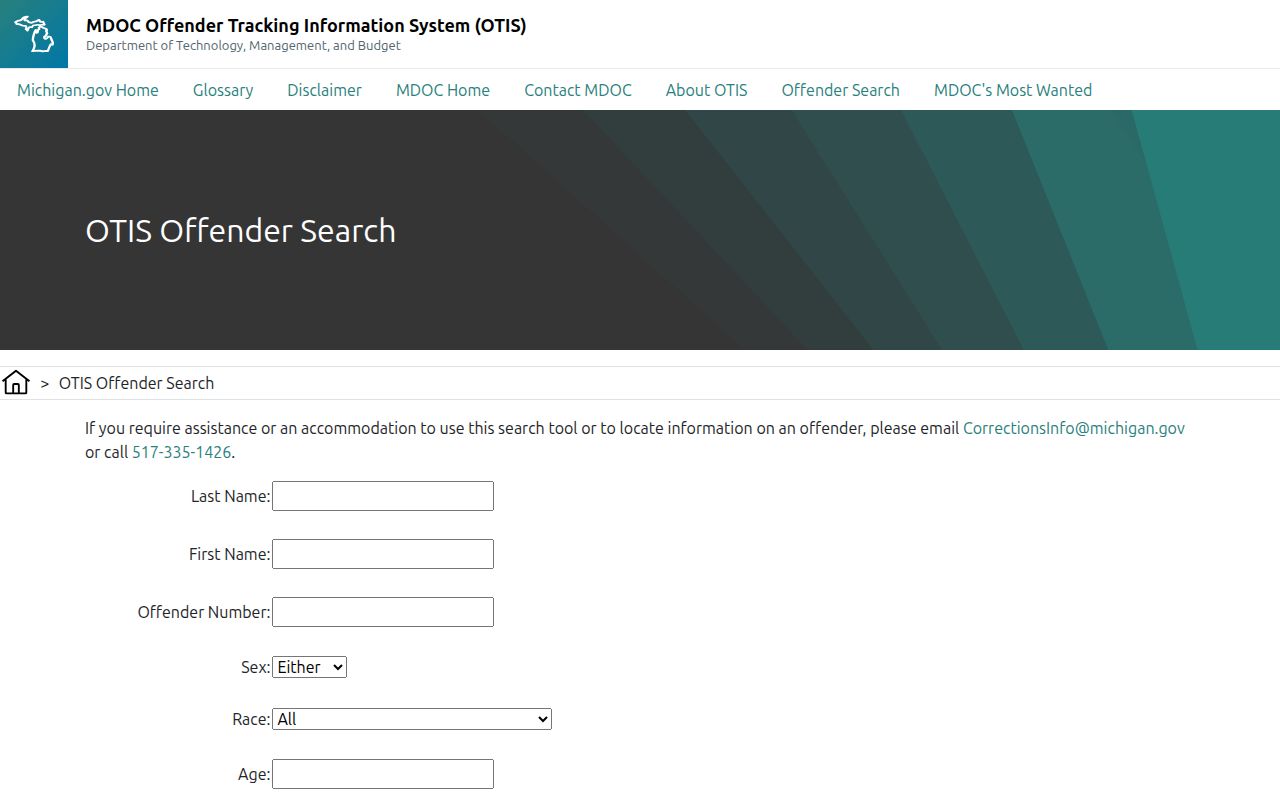
The form helps find a profile, but the profile’s live label controls. Never turn an Earliest Release Date into a guaranteed release date.
Note: A pretrial Cheboygan County detainee has no fixed sentence-release date while bond, court action, processing, and holds remain unresolved.
Cheboygan ERD and Parole Timing
Michigan uses indeterminate felony sentences. The court sets the minimum within the legal framework, while the statute sets the maximum. For an applicable sentence, the Board generally gains jurisdiction after the minimum. It can grant or deny parole. The MDOC parole consideration process begins about six months before eligibility or reconsideration, but review is not release.
A positive case moves to the Parole Release Unit. MDOC states that a minimum period of 28 days generally separates the Board’s release decision from physical release. Staff must address placement, the parole order, conditions, and other processing. A grant therefore precedes the final event. For denials, MDOC describes reconsideration in general as yearly for high or average guideline cases and up to two years for low-score cases. Those are general process intervals, not a county-jail penalty.
The official decision and release timeline illustrates why a Board decision date and a prison exit date should be kept separate:
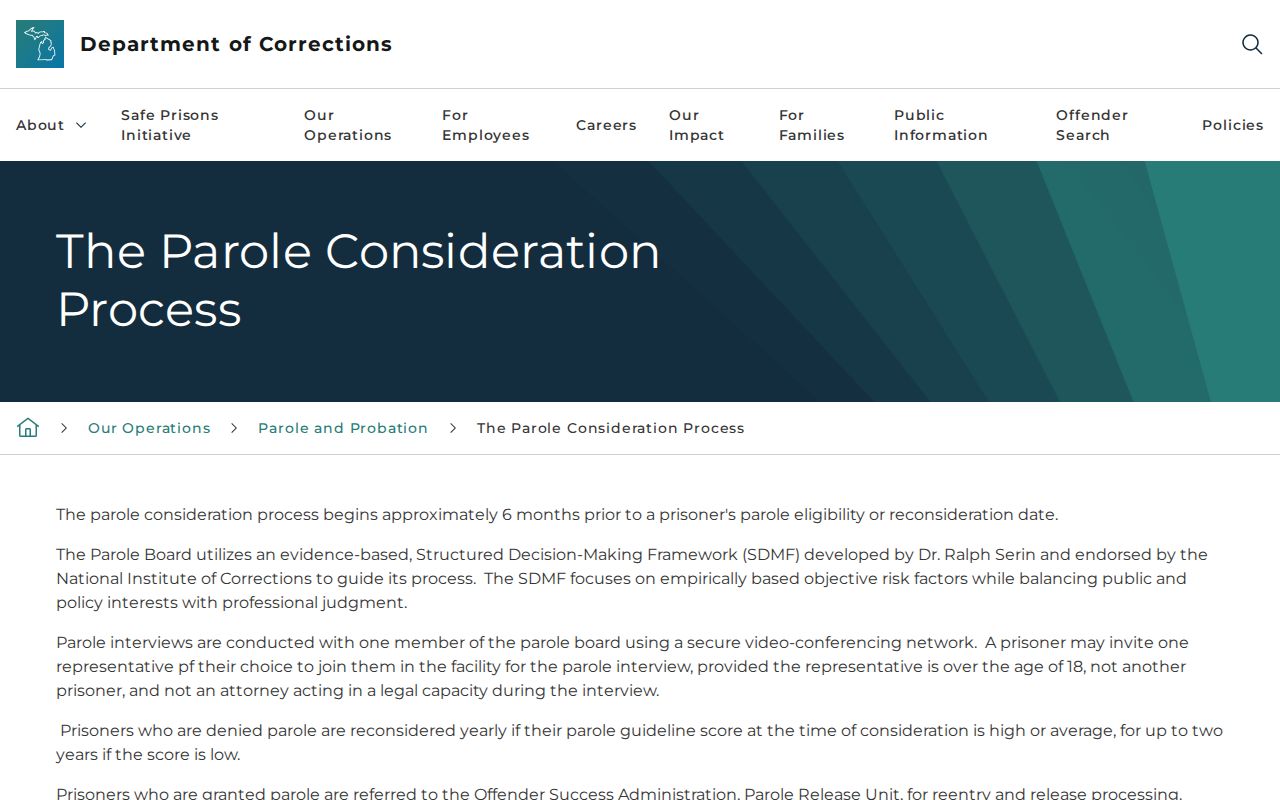
The sequence explains the gap without promising a date for any one person.
Cheboygan Release Credit Rules
Michigan is not governed by a universal “serve 85 percent” calculator. Truth in sentencing went fully into effect in December 2000. For affected offenses, a person must serve the full judicial minimum without good-time or disciplinary-credit reduction of that minimum. Older offenses and sentences can remain subject to earlier credit regimes, so the offense date, sentence, and exact statute matter.
MCL 791.233(1)(e) bars parole before service of the minimum except for legally applicable credit allowances. MCL 791.234 addresses Parole Board jurisdiction and sentence-specific rules. Older good-time and disciplinary-credit frameworks appear in MCL 800.33, while MCL 800.34 addresses disciplinary time for specified truth-in-sentencing offenses.
Do not subtract 15 percent from a sentence. That shortcut is unsupported and can yield a false Cheboygan County release date. The live sentence data, controlling statute, and MDOC computation must be read together.
The maximum sentence does not become a promise that custody lasts until that day. A lawful parole can occur after the minimum when the Board grants it and processing is complete. Conversely, reaching the minimum does not force a grant. This is why both ends of an indeterminate sentence must remain tied to their actual labels.
Note: Michigan credit statutes must be matched to the offense and sentence date; no single percentage produces a reliable release date.
Cheboygan Jail Release Computation
A county-jail sentence follows a different path from an MDOC prison sentence. The Cheboygan calculation may involve the judgment, credit for time already served, concurrent or consecutive terms, warrants, detainers, and the jail’s execution of the court order. A pretrial release may turn on bond or a new court order rather than any sentence calculation.
No official Cheboygan County page publishes a county-jail good-time formula, weekend or holiday early-release rule, or public projected-date calculator. That absence is a key local finding. Do not apply the MDOC Earliest Release Date framework to the county jail. Review the judgment through the 89th District Court or the correct felony court, then ask the Cheboygan County Jail for an existing time or release record. The 53rd Circuit Court records page explains that the County Clerk maintains circuit files.
The result should preserve its source. A judgment can show the sentence and credit. A sheriff record can show the physical exit or transfer. One should not be presented as if it were the other.
A focused local request should seek an existing time or release record, not ask staff to invent a projected date. Include the full booked name, booking number or birth date when known, the case, and the relevant date range. Ask for release date and time, disposition, and a receiving agency field if the event may have been a transfer. Michigan FOIA permits access to nonexempt existing public records, but exemptions and redactions can apply.
Why Cheboygan Release Dates Change
A date can move, remain conditional, or appear not to match because it never represented a guaranteed exit. Record the label before looking for a reason. Eligibility, an outside sentence date, a Board decision, and an actual release timestamp belong to different stages.
| Factor | Possible effect | Best source |
|---|---|---|
| Parole grant, denial, or deferral | Starts release processing or moves consideration to a later point | Board order, OTIS status, and MDOC records |
| Multiple sentences | Concurrent or consecutive terms alter the controlling calculation | Judgment and sentence computation |
| Detainer or warrant | Can lead to transfer or continued custody after one case ends | Jail or MDOC record and receiving authority |
| Misconduct or disciplinary time | Can affect treatment under the governing credit regime | MDOC time computation and applicable statute |
| Court correction | Can change sentence data that feeds OTIS | Sentencing court and updated MDOC record |
| Public data lag | The displayed status may trail the agency event | Originating agency and date-bearing release record |
A transfer is especially easy to misread. Leaving the Cheboygan County Jail does not mean arrival in the community when another agency takes custody.
Public data can also expire without changing the underlying event. OTIS generally displays people discharged from MDOC supervision during the prior three years. Formal proof after that public window may require MDOC records, including a Discharge Certificate or PENPACK material. A blank search years later is therefore not a release-date finding.
Correct Cheboygan Release Date Errors
MDOC explains that much OTIS offense and court information comes from court records. Take a court-data error to the sentencing court. Address supervision or absconder information to the supervising field office. MDOC updates OTIS when directed by the court or other proper official. This correction path is more reliable than trying to recalculate a sentence from a short public profile.
For final confirmation, use the custodian that performed the event. The sheriff confirms a Cheboygan jail release or transfer. MDOC confirms prison release, parole, and discharge records. Michigan VINE can provide a prospective custody-change alert, but it is not a certified archive and may lag. Registration steps are covered in the VINELink Release Check. For a durable local search path, use the Cheboygan released-inmate record guide.
For older MDOC proof, a focused records request can seek a Discharge Certificate, Basic Information Sheet, sentence-computation entries, or parole order. Keep the requested record narrow and identify the person with the MDOC number when possible.
When the source is a court correction, retain both the corrected order and the later agency display. When the source is the sheriff, retain the booking or release transaction. That paired record explains why an earlier public date changed and preserves the difference between legal authority and the event that followed.